

O Henry (1862-1910)
I get the feeling that some literary snobs might look down on O Henry. To them I bite my thumb. O Henry is just super fun to read. His stories focus on a time, place, and class of people that might not be found in the history books too often, but working class people in New York or in the west make for some great characters. Generally you get a great setting, mostly New York, a colloquial talking character and a twist at the end. The narration is also playful and creative. This guy's the master. Start with "The Last Leaf" and go from there.
Rating 9.5/10: Nothing will cheer you up or bring a tear to your eye in 15 minutes better than an O Henry story.
Sunday, July 8, 2012

Monday, June 4, 2012
Bel Ami
Guy de Maupassant (1850-1893)
I know Guy from his short stories, most notably "The Horla" so I was expecting some twisted mental anguish with a little touch of the supernatural. So boy was a surprised when I got a realistic novel about Third Republic France and the ins and outs of social advancement in journalism. Georges Duroy is our main character, a small time former soldier who gets a grunt job at a newspaper through a chance encounter with a former military friend. Georges is swept up into the world of intrigue and high society and that's when Bel Ami gets really French. Dinner parties, torrid love affairs, rendez-vous with married women and the seduction of everyone in sight typify Bel Ami. Each conquest Georges makes, and there are many, is mostly strategic and only somewhat romantic. We see him progress from a rank amateur writer to a slashing gossip columnist and political reporter, he makes the same change in his love life. He initially seduces women for love or at least the thrill, later in the book he makes his moves with calculated conniving. His attitude is best summed up by his first wife, Madelaine. When he's given the Legion of Honor, an event that would have been unthinkable just a few years before, he scoffs at it, thinking he deserves more. "You're never satisfied," she says (roughly).
The think I find most French about this book is that Georges, who's a bit of a dolt and heavy handed with his sweet talk never gets caught and keeps reeling in these smart, rich, uppercrust women. I kept expecting him to get caught and challenged by a jealous husband, found in flagrante delicto by one of his other lovers and murdered, but no, he goes about his merry way becoming richer and richer, casting women aside when he sees a chance to improve his position. It's not very satisfying, but it's probably a more realistic portrayal than if Georges would have got his comeuppance.
Rating 8/10: Lots of really good stuff in here. Georges shark-like focus makes this book pretty dark, but what else do you expect from Guy de Maupassant. After all, the guy's grave reads, "I have coveted everything and taken pleasure in nothing."
 |
| Vampire Guy as Georges? Could work I guess. |
The think I find most French about this book is that Georges, who's a bit of a dolt and heavy handed with his sweet talk never gets caught and keeps reeling in these smart, rich, uppercrust women. I kept expecting him to get caught and challenged by a jealous husband, found in flagrante delicto by one of his other lovers and murdered, but no, he goes about his merry way becoming richer and richer, casting women aside when he sees a chance to improve his position. It's not very satisfying, but it's probably a more realistic portrayal than if Georges would have got his comeuppance.
Rating 8/10: Lots of really good stuff in here. Georges shark-like focus makes this book pretty dark, but what else do you expect from Guy de Maupassant. After all, the guy's grave reads, "I have coveted everything and taken pleasure in nothing."
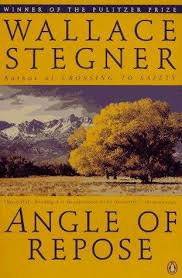
Angle of Repose
Wallace Stegner (1909-1993)
If I was a good writer instead of a middling historian this is the kind of book I would write. Stegner uses the letters of Mary Hallock Foote, a Gilded Age artist who moved out west with her engineer husband, and creates a fictional story around them. In the hands of Stegner these letters gain context and reveal a place and time in America. By layering this narrative with that of Lyman Ward, the fictional professor emeritus, and grandson of the fictionally renamed artist Susan Burling Ward, we not only get to view Susan & Co.'s lives through the prism of the early 1970s, we get a glimpse at the great character that is Lyman Ward.
 Lyman is wheelchair bound and struggling to stay out of a nursing home. His delves into his grandmother's life, submerging himself to the point where he's more involved in it than with his day to day life, as a way to prove that he's still relevant. What we end up getting is Lyman commenting both on the era around 1900 and the early 70s and their relation to each other. Lyman's assistant, the free-loving Shelley, questions the prudery and stuffiness of the Victorians. It is here when Lyman describes how foolish we are to look back in time and assume our ancestors are foolish. Where we see prudery about Vicorian sexual mores and discourse, they saw propriety. Lyman argues that the Victorians would feel that modern Americans are just as repressive and reluctant to talk about death out in the open as they were about sex.
The story is also one of movement. Susan moves every few years from one ramshackle mining camp to another. Her husband, most of the time through no fault of his own, leaving one failed project after another in his wake. This is sharply contrasted against Lyman who literally is stuck in his grandparents' old house and doesn't want to go anywhere.
Stegner masterfully weaves Susan Burling Ward's letters into Lyman's memories, revealing why she acted the way she did and making her a much fuller character to both the reader and to Lyman.
Rating 10/10: Brilliantly done.
If I was a good writer instead of a middling historian this is the kind of book I would write. Stegner uses the letters of Mary Hallock Foote, a Gilded Age artist who moved out west with her engineer husband, and creates a fictional story around them. In the hands of Stegner these letters gain context and reveal a place and time in America. By layering this narrative with that of Lyman Ward, the fictional professor emeritus, and grandson of the fictionally renamed artist Susan Burling Ward, we not only get to view Susan & Co.'s lives through the prism of the early 1970s, we get a glimpse at the great character that is Lyman Ward.
The story is also one of movement. Susan moves every few years from one ramshackle mining camp to another. Her husband, most of the time through no fault of his own, leaving one failed project after another in his wake. This is sharply contrasted against Lyman who literally is stuck in his grandparents' old house and doesn't want to go anywhere.
Stegner masterfully weaves Susan Burling Ward's letters into Lyman's memories, revealing why she acted the way she did and making her a much fuller character to both the reader and to Lyman.
Rating 10/10: Brilliantly done.
Wednesday, April 18, 2012
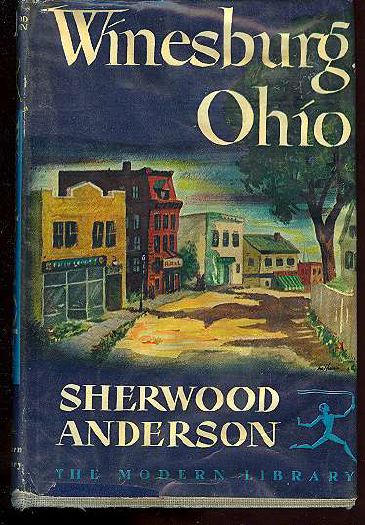
Winesburg, Ohio
Sherwood Anderson (1876-1941)
If nothing else Winesburg is an interesting experiment in form. There are two things that link together the twenty-four stories: George Willard and the small town of WInesburg. George lives in the main hotel which his family owns but he is also a newspaperman. If you read a paper from back in the 1910s you might notice that WInesburg is kind of like those publications. It's similar in that the reader learns bits and pieces of everyday life and maybe a bit of gossip about the townspeople, what Anderson does that's interesting though, is delve deep into each character's psyche. It's not George as reporter telling us these things, it's like the town itself if gleaning information from it's residents. And Winesburg itself is a major player in the book. It's got the get up and zip typical of early 20th century towns but at it's core there seems to be a depressing pall hanging over everyone.
This enthusiasm on the outside and deep psychological distress on the inside is reminiscent of Sinclair Lewis book but this seems much darker. So that's what I liked about Winesburg, there's a lot that I wasn't so keen on. The flow of the stories didn't make this book easy to read. Generally we get a picture of George growing up in relation to whoever's story is being told, but there are times when we jump around many years. It's hard to get a really good feel for George, though, because each individual story doesn't really have a beginning, middle and end. They're more just character sketches, really awesome and penetrating character sketches, but not especially fun to read twenty-four in a row. Publishers were hesistant to move forward with Winesburg because, well, it's super depressing. The only way to be happy in life is to get the heck out of town. That's what George does at the end, but there's no feeling of connection to him because we don't really know the guy.
Rating 5/10: Not sure this should be a story collection. Maybe Anderson needed an editor to tell him to connect the stories better, that'd be my advice. But that doesn't change the fact that there's some extraordinary writing in here and I'd be eager to read something else by Anderson.
Wednesday, March 28, 2012
Henderson the Rain King
Saul Bellow (1915-2005)
Now this is a novel. Bellow manages to weave brilliantly complex characters with both philosophical discourse and a rollicking plot. Eugene Henderson is a brash, privileged, wealthy North easterner. He is manic, troubled and to an outsider could be considered insane. He takes shots at cats, rails against his wife, shows up in French churches hammered and wants to become a doctor in his early sixties. Henderson is endearing rather than annoying because we get to see what's going on in his head. As crazy as his act is, it kind of makes sense.
Henderson is telling his story after the fact. He's returned from Africa and is back in the US. He has a voice in head that keeps saying, "I want! I want!" He isn't satisfied and he doesn't know what it will take to fill his yearning. He meets a guide named Ramilayu who serves a protector and voice of reason. Henderson comes into contact with two tribes from whom he learns about life and what he needs to live. There is a lot of philosophizing in the Henderson , I'm talking pages and pages worth. But it's not only readable, but it's enjoyable because the characters are interacting with each other and revealing a lot about themselves in the process. Dahfu, king of the Wariri, plays on Henderson's personality to trick him into becoming the Rain King. This intense relationship forms the basis for the second half of the book.
Rating 9/10: Loved it. Also, exploding frogs.
Sunday, March 18, 2012
The Return of the Native
Thomas Hardy (1840-1928)
Thomas Hardy, old reliable. Some pastoral England, a good love story, a realistic look at relationships and sex free of Victorian restraints and you've got a Hardy novel. All these are present in Native but it can't overcome one thing, this novel is frightfully boring. I'm talking stultifyingly, Math for Liberal Arts 101 at eight AM boring.
We're in Egdon Heath, a small town located in the desolate rolling hills of mythical Wessex. Sounds like a cool setting, right? Bonfires on hills, rolling fog, crazy storms, yeah, I can get down with that. The problem is nothing happens for the entire first half of the book. We meet some characters: the feckless Thomasin, conniving wishy washy Damon Wildeve, the nosy Diggory Vann, and the scheming Eustacia Vie. Eustacia is sort of intriguing, she wants out of Egdon, and is desperate for the bright lights of Paris. That's why when Clym, the Native of the title, returns from a lucrative job in France, she's all about meeting him and hitching her star to his ascending wagon. Keep in mind this is 200 pages into the book and we haven't even met Clym.
So we end up with Thomasin and Wildeve as a couple and Eustacia and Clym as a couple. It's obvious from the start of these relationships that Thomasin/Clym and Wildeve/Eustacia should be the matches. What follows is a series of farcical misunderstandings so ridiculous Georges Feydeau rejected them. Simple details are left out of conversations, meetings are missed by minutes, people infer things that are patently wrong, and then a bunch of people die. In a door slamming farcical comedy these misunderstandings are funny, in a tragedy it just seems kind of dumb and pointless.
Rating 3/10: Shouldn't be a classic. Too boring, not one likable, or really even interesting character.
Thursday, December 29, 2011
The Damnation of Theron Ware
Harold Frederic (1856-1898)
Show me some Realism from the 1890s and I'll show you an top-tier classic. Why? Well because the Gilded Age is the most fascinating time in American history. It's a bridge time that gets us to what we know as Modern America. Everything is changing and it's changing fast. Opportunities are opening and closing for different classes, races, and regions. Sleepy backwaters are being pulled into the Twentieth Century by the power of electricity and mass communication. Optimism and ambition rule the day.
This is where we find Theron Ware. He's a Methodist preacher in rural upstate New York (I'm pretty sure it's New York). Theron is ready to hear his named called for a plum position at the big Methodist conference but he's passed over and sent to Octavius, which is the opposite of plum, prune I guess. He and his pretty wife Alice move to Octavius and try to make the best of it. They are confronted, however, with very traditional members, a very stingy board of directors, and whole load of Irish Catholics. At every turn Theron is slowed by the church elders, they aren't impressed with his oratorical ability, they just want the old timey hellfire and brimstone. It is in this dark spot that three things occur which lead Theron down the road to damnation.
The first is the flower garden. His wife takes to gardening in a major way. She gets plants from a rich man in town who buys them for her and expects nothing in return. Theron thinks little of this arrangement at first. Next is his meeting with Celia Madden, an Irish Catholic with some unconventional views and some conventional hotness. The red head intrigues Theron, Catholicism is so foreign to him that she and her church hold a mysterious allure to the protestant preacher. The third is the boarding of two fundraisers for the church with the Ware's. The Soulsbys arrive in town to fire up the congregation and get some cash flowing into the debt-ridden church. Candace Soulsby is an engaging, smart, theatrical woman who's been around the block and ends of serving at Theron's guidence counsellor/physiologist.
The result of these events is a revaluation of Theron's life and its direction. The worldly Madden makes Theron feel like a rube. Soulsby makes Theron realize that not everyone has to be genuine in their religious fervor. The flower problem starts Theron into questioning his wife and imagining other ways to live. Theron's transformation is quick. He changes from a naive by sincere preacher of the gospel to a scheming, but pretty dumb, preacher who desperately wants to be cosmopolitan.
Theron's actions, stepping over the Catholic/Protestant divide in Octavius, becoming a stranger to his wife, courting Celia, backsliding in his religion, lead him to a desperate situation that nearly costs him his life and does cost him his livelihood.
Lots of cool stuff in this book. It's crazy how the Irish are treated as a seperate race from the WASPs in Octavius. Their ceremonies and even their church picnic with its lager beer might as well be from Mars. Celia is also a cool character. Modern and sophisticated in her outlook, but just as confused about what she wants as Theron. Her machinations with Theron are suspect and never totally fleshed out.
The themes here are great, we've got the role of women, religion and its relevance in a scientific world, race and class and how that dynamic affects relations in a small town.
Rating 9.5/10: Loved this book and would have given it a ten if Theron's breakdown had more depth. Still, loved the characters, the setting and the themes.
Thursday, December 8, 2011
Redburn: His First Voyage
Herman Melville (1819-1891)
Herman Melville writing a book about the travails of going to sea, what a shocker. Write what you know is the mantra and Melville does it, and does it a lot. But if you think you're going to get another Moby Dick, well, you're wrong my friend. While Ismael puts the reader through torturous never-ending descriptions of whales, Wellingborough Redburn is a more interesting narrator, yeah I said it. Redburn is a painfully naive kid from up the Hudson who decides it would be a great adventure to head across the Atlantic and see England. He comes from a formerly wealthy family and carries himself as such. Everything we see in Redburn comes through his inexperienced eyes. The picture of New York City in the 1840s is amazing. The thriving port is a living, breathing place full of characters, beautiful ships and not so beautiful goings on. After Redburn finds a job on the Highlander he's in over his head for the entire book.
The first thing I want to cover is the voice in this book. It's semiautobiographical and Redburn is a greenhorn. He looks down on the sailors for their manners and habits. Drinking and smoking and any other vice is not pooh poohed as much as it is looked on with shock and a desire to reform. He belongs to an anti-drinking club and an anti-smoking club back home and criticizes the non-stop smoking and drinking that happens ashore and on board. Now I'm not really sure Melville isn't poking fun as his younger self here. Redburn is so naive and innocent it seems like a put on at times. It is this wedge between Redburn and the rest of the crew that provides much of the conflict and humor in the book.
There are lots of great characters in Redburn, the contemptible Jackson, the weird and perhaps homicidal Barry and the immigrant Carlo. I think the book is most notable portion of the book is the tribulations of the immigrants on the passage from Liverpool to New York. The mostly Irish bunch, around 500, are housed in incredibly cramped and unclean conditions. They have one fire to cook over and only have a very rudimentary idea of the duration and hardships they're going to face. In many ways their experiences and surprise at the conditions mirror the feelings that Redburn has on the outward voyage.
Redburn might not be as deep and important as Moby Dick, but it's more consistently entertaining and paints a better picture of life ashore.
Rating 7.5/10: A fun fast-paced read with lively characters and interesting social commentary.
Sunday, September 11, 2011
Lady Audley's Secret
Mary Elizabeth Braddon (1837-1915)
This thing is classified as a "Sensational Novel," because it centers on a something sensational and it was written between 1850-1880 in Great Britain. So pretty much every novel during that period. Now you'll have to excuse me because I read this book a few weeks ago so this review is going to be quick and dirty. Lady Audley marries Sir Michael Audley and everything seems to be fine. Lady A was a servant girl who married the much older man and moved in with him and his 20 year old daughter. Even though there's tension between Lady A and her new daughter-in-law everything is going pretty well until Robert Audley, nephew of Sir Michael, meets his old army buddy George Talboys. Now George has been in Australia hunting gold for three years because his life sucked before that being married and poor with a kid. George didn't go on this trip the most noble way, abandoning the family in the middle of the night and hoping to strike it rich and return to them.
This book really is a pretty good mystery so I don't want to give away too much plot, so a few words about style and themes. Lady A's Secret moves along at a pretty swift clip and has one great character. Robert Audley is a super lazy lawyer. He doesn't really practice law and most people think he's dumb. Luckily he's not dumb, he just enjoys an idle lifestyle. The mystery that pops up around George Talboys, Lady A. et. al. spurs him into action. Being constantly underestimated works out to his advantage as he turns into a private detective.
Lots to think about as far as gender and identity here. Lady Audley has been treated really badly in her past, she's taken matters into her own hands and has ended up in a great situation with Sir Michael. Does she get a standing ovation? Nope, just a one way ticket to the looney bin. Does her agency warrant such a fate? She is strong and determined, but she is also manipulative and dishonest. George Talboys is a real a-hole, he ditches his family and parties in Australia for three years before cashing in and heading home, expecting everything to be cool with the wife. The rest of the characters in the book seem to think his actions are fine. Lady Audley does some things that probably aren't as bad as George and she's shipped up to a nut house on the continent. It was good to see that Braddon didn't neuter her as a character, Lady Audley stayed as defiant and tough right to the end.
Rating 8.5/10: Good mystery, great characters in Robert and Lady A, some interesting themes and exciting writing.
Sunday, August 7, 2011
The Adventures of Augie March

The Adventures of Augie March
Saul Bellow (1915-2005)
The third Bellow book that I've read on the list after Herzog and Humboldt's Gift. Not your typical novel. We follow Augie March, a likable normal guy from Chicago, around from adventure to adventure which is all a grand buildup for, well, nothing. There is no grand finale here. What the reader gets is a lot like real life, no happily ever after, just onward to more challenges and opportunities.
Augie is born into a down on their luck Jewish family around 1920 in Chicago. Apparently the first paragraph is very famous for its declaration of Americaness, but I didn’t notice it the first time around. Augie seemed about as American as you can get, resourceful, immigrant family, good natured but makes some questionable choices.
Augie March is all about fate. Augie muses on it often. The characters he encounters, the trips he takes (smuggling immigrants in a stolen car, working at a pool hall, stealing books for profit, teaching an eagle to hunt, and excursion to Mexico, getting sunk by a Japanese ship in the Pacific) all seem to inflict themselves on Augie. He reacts to the different circumstances, but does he really have any agency over what his future will be?
Augie himself is an interesting character, streetwise but philosophical. He’s as good at hitching rides and avoiding the law as he is at opining on ancient Greeks. The book is more valuable, however, in its depiction of the Great Depression. Chicago is tough and gritty, filled with guys trying to make a buck whether it’s honest or not, and women who are tougher and more resilient than the men. There’s a gap between the rich and poor which Augie straddles precariously at times, at others he struggles to break through, and sometimes he revels in a Bohemian lifestyle.
I thought Herzog was a more impressive work by Bellow. It’s main character was more interesting. If I could change Augie (and yeah, I know Saul Bellow probably isn’t super pumped to have a hack edit his classic) I would have had Augie get in on the plan to protect Trotsky in Mexico. Bellow was scheduled to meet with the Russian leader the day he was assassinated, it would have been neat to see Augie deal with a big historic event, it also would have served as a climax and set up an extended denouement with WWII serving as closure of Augie’s wanderings and an entrance into the next phase of his life. Maybe that’s the point though. We don’t live our lives like a novel. If we succeed or fail we don’t get a handy “The End” as the sun sets. We move on to the next thing, or fight off whatever fate has in store for us.
Rating 6/10: Loses steam after the Mexico trip. Great characters, great plot points, seemingly no story arc (but that’s probably the point).
Sunday, June 26, 2011
A Room with a View
EM Forster (1879-1970)
Firstly, do you think there's another span in history where more stuff changed than 1879-1970?
I've tried to get into A Passage to India several times and never had much luck, so I was a little nervous when BJ Harrison announced he was doing a 10 part series reading A Room with a View on his awesome podcast. I was pleasantly surprised with how much I liked this short novel. The characters are lively and fun, and you can tell Forster is really smart without him beating you over the head with it.
Lucy Honeychurch is on vacation in Italy when she meets an odd father/son duo named Emerson. Dad is kind of an outside the system proto-hippy and his son George is kind of a down in the mouth philosophical dreamer. Lucy is probably 20, struggling to find her place in her stuffy Edwardian era social circles. Forster introduces us to a full cast of characters in Italy from the most embarrassing tourist to the most seasoned traveler who's still embarrassing because they think they're Italian.
The Emerson's are notable because they refuse to abide by social norms, they tell things like they are and don't sugarcoat anything. They become a curiosity but not someone that polite people want to be seen with. This awkwardness comes early when the Emerson's hear Lucy and her companion opine about having a better view from their hotel room. When the Emerson's offer to simply switch rooms with the ladies all sorts of social ramifications are set into motion. On a trip to the country the couple kiss and are caught in the act by Lucy's cousin. This act of impropriety ends part one.
Part two is back in England where Lucy is engaged to Cecil, who, to be frank, is kind of a dick. He talks down to women, is really boring, and won't play tennis. Another string of occurrences lead the Emerson's to town where George renews his courting. Lucy loves him, but he's not an acceptable match. She breaks it off with Cecil and decides to bolt for Greece before she meets one more time with Mr. Emerson who convinces her to get with George. They're married and hanging out in Italy, her family is mad but they'll get over it.
Two big themes in Room, adhering to society's expectations versus being free and the role of fate. The dichotomy between the Honeychurch's and the Emerson's is clear, societal rules or be free. Luckily Forster made the whole situation more nuanced than that. Because the Emerson's are so rigid in their screw the system attitudes they are almost as trapped as the Honeychurch's. Emerson and Lucy think about how fate plays into their lives. So many coincidences and long shots have to come through for them to be together. Lucy tries to avoid George even though she loves him, but he just keeps appearing.
Rating 6.5/10: It's a cool inspection of British customs in the early 1900s and the characters are interesting, but not much in the way of plot.
Saturday, June 4, 2011
Little Dorrit
Charles Dickens
I'm back baby! Little Dorrit almost derailed me with its terribility, but I survived. This is Dickens, A Christmas Car, Great Expectations, Oliver Twist, A Tale of Two Cities etc. etc., so we should be pretty safe picking up one of his books. Even Dickens worst, Bleak House, was endearing after a slow start. Well, Little Dorrit is a big letdown. Memorable characters are limited to Flora, the motormouthed ex-girlfriend of the bland and boring Clennam.
We start in prison in France, a moderately interesting scene with a man named Rigaud who allegedly killed his wife and has switched identities several times. Sounds pretty rad, right? So there's your villain. We ditch Rigaud for awhile before he returns with a nefarious plot, perhaps the worst thing a person can do, blackmail an old woman with a moderately embarrassing secret from 45 years ago. Oh the excitement.
Most critics would say the real villain in Little Dorrit is the debtors' prison and the lack of a social safety net. We find the title character and her father in Marshalsea Prison, they've been screwed over by Clennam's mom who's a real piece of work. The prison is a community unto itself with interesting social interactions and a hierarchy of leadership.
By the end of the book everyone is back to being poor and living in the prison. except for Mrs. Clennam because of bad investments. Normally I don't like to spoil the endings of the classics, but let's be honest, none of you are going to read Little Dorrit. I also want to review the end because it is outrageously stupid.
Rigaud blackmails old lady Clennam, she pretty much tells him to eff off, and, after sitting in a wheelchair in her house for 20 years she gets up, leaves the house and heads to Marshalsea to tell Little Dorrit she's sorry. This accomplished she heads home only to pass out in front of her house which promptly collapses, killing Rigaud. I'm not making that up, Charles Dickens actually wrote that climax. I have a feeling he was about 10 pints deep into the wassail.
The relationship between Little Dorrit and Clennam is also strange. Clannam is a 40ish business man who's sort of estranged from his mother. Little Dorrit takes care of her dad in the prison, she's 16. Clennam becomes her protector and they fall into tepid love with each other.
Rating 3/10: Boring, contrived, no characters worth caring about. This makes two Dickens books on the classics list that don't belong. Dorrit & Drood.
Tuesday, January 11, 2011
The Warden
Anthony Trollope (1815-1882)
The Warden is the first of six novels about the town of Barsetshire. Naturally, I read the second novel, Barcester Towers, first. No one should ever accuse me of being smart. BT was a few years ago but I remember liking it quite a bit, some biting satire and standout characters. Trollope is like a more personable Dickens with less eventful, if more realistic plots. He seems gregarious and friendly as a narrator than his more famous countryman.
The Warden details the controversy surrounding the right of the church to bestow 800 pounds to the warden of an old folks' home when the will it draws that right from explicitly states that money is to go to the old folks at Hiram's Hospital. The church is basically ripping the poor, infirm workers off and has been for years. Who's stuck in the middle but Septimus Harding (cool name) a kindly, meek, and benevolent man of the cloth. The problems start when an equally well meaning laymen, John Bold, decides to take up the cause of the poor guys. Things are complicated by three facts: 1) Bold is in love with Harding's daughter Eleanor and she loves him 2) The archbishop is a big blustery fellow by the name of Grantly who is vehemently against Bold and also married to Harding's other daughter 3) Septimus Harding has a conscience that won't let him overlook ripping off old guys.
The novel follows Harding's struggle with the lawsuit, his ideas about fairness to the inhabitants of Hiram's hospital and his loyalty to the church. He is devastated when a few editorials appear in the all powerful Jupiter newspaper blasting the warden for his greed. The editorials are really the last straw, they deeply affect Harding and he decides to head to London to confer with the church's lawyer, an action of betrayal to the archbishop. After the lawyer can't even begin to explain why the warden gets the 800 pounds a year Harding makes up his mind to retire from the position. And that's pretty much the whole book. Eleanor and Bold get married, the end. What we've got here is really the introduction to Barchester Towers, a much more nuanced and complicated tale. The nice thing about The Warden is that we get a look inside the mind of a very good man. Once the issue of fairness is brought up to Harding, Trollope shows the wheels moving in the old man's mind. The thought process that leads him to resign from the wardenship and take a ton less money is the center of the tale.
Rating 5/10: I liked The Warden, but it should have just been tacked onto Barchester Towers.
Sunday, January 2, 2011
The Dreams in the Witch House
H.P. Lovecraft (1890-1937)
One of the shortest of the classics, you can find Witch House here. We meet poor Walter Gilman after he's already made a fatal mistake. A math major in college, he becomes obsessed with the tales of a witch who was executed 300 years ago in his town. This witch, Keziah Mason, bragged to the court that she had discovered a fourth dimension. Gilman decided, or was drawn, to move into Keziah's former garret room which was still extant.
The small room is plagued by rats and has two small enclosures that have long been inaccessible. Lovecraft guides us between Gilman's distressing days and his mindblowingly abstract and horrible dreams. Within the dreams Gilman alternates between seeing horrible apparitions of an old crone, a small human-like rat named Brown Jenkins, and a giant Black Man and some really trippy scenes where he is transcending time and space surrounded by space and odd shaped entities.
I don't want to give away the story save to say Gilman is pulled farther and farther into the insanity of the dreams until they cross over into his awake life. I do want to comment on the dreams. Lovecraft's dreamworld reads more like an analyzation of an LSD trip from the 60s. The division between the real and the dream world becomes smaller and smaller until they finally merge. Some creepy, mindbending stuff.
Rating 7/10: A lot packed into a short story. Need to get through more Lovecraft stories in this series before giving it a final rating.
Monday, December 27, 2010
David Copperfield
Charles Dickens

There is an awful lot of Charles Dickens on the Penguin list of classics, some of it not so great (Edwin Drood) some of it totally awesome (most everything else). Copperfield falls into the awesome category. It's a sweeping, semi-autobiographical novel full of memorable scenes and more memorable characters. The bad guys are really bad and the good guys are really good and there are even some people who occupy a nuanced, grey area.
This is Copperfield's book. He is writing it at a time after he has become an accomplished author looking back on how he got there. He has a unique voice, enthusiastic and emotional, that makes the book chug along even when it hits some slow spots.
The characters are what make Copperfield, otherwise it's a slightly overdramatic plot with criticisms of several of Britain's institutions. Uriah Heep, Mr. Micawber, Steerforth, Mr. Dick, Miss Dartle, Peggotty, Aunt Betsey, Dora and on and on. Heep is particularly noteworthy for his capability to be hated for his humbleness.
As for the plot we see David's whole life. He loses his secure place in society when his mother remarries and scrambles for everything he gets from there. There are many who help and hinder him on his path to adulthood. There are even a lot of twists and turns that I didn't see coming, The Tempest chapter is dramatic and touching, there might have been some tears shed in one of the death scenes as well.
Rating 9/10: High level Dickens. Touching, entertaining, funny, and memorable; this one deserves to be in the list.
Sunday, October 24, 2010
Bleak House
Charles Dickens
A long, interminable, mindnumbingly infuriating, suicide-inducing court case screws up a family and leaves everyone's lives in ruin. That's pretty much Bleak House. The only good thing that happens for the first 4/5s of the book is the reunion of a minor character and his mother. Everything else is, well, bleak. Esther is the main character. She's the right hand lady of Ada. Ada and Richard are involved in the lawsuit of Jarndyce v. Jarndyce. They are introduced to each other and the suit by the benevolent John Jarndyce. John tries to shield them from the fools gold of a court victory. Guess how well that plan works.
Bad stuff starts happening after Richard and Ada fall in love. Richard is a slacker, Esther gets sick, some philanthropists are jerks, Richard obsesses about Jarndyce, a kid dies, Esther is disfigured because of her illness, not great times. There are some notable minor characters in the novel. The Mrs. Jellyby, who care more about saving Africa than her own family, Miss Flight who's attended Jarndyce sessions forever.
This thing really takes a long time to get its legs. Once it does, though, there's a lot of good stuff. Esther and her mom, Richard's descent into obsession, John and Esther's relationship, all interesting and the theme of the injustice of the justice system is everywhere.
Rating: 6/10 Too long, conflict and drama not all that dramatic.
Sunday, August 8, 2010
Herzog
Saul Bellow (1915-1905)
 Reading this book made me feel like I was back in grad school. There were times when I'd sit in a small classroom with seven or eight other students and a professor and feel profoundly dumb. I'm not talking about how I felt in math class where I didn't care whether I knew what was going on, I was legitimately interested in the subject matter and tried to understand it and still had no clue what other people were talking about. Saul Bellow's command of language and a turn of phrase is something at which to marvel. His knowledge base is vast. He delves into psychology, history, sociology, literature, all in telling the tale of Moses E. Herzog. The narrator is omniscient, but has the voice of someone who could have been friends with Moses or perhaps even Moses looking at his own life. Much of the story is told through Moses's letters that he writes to just about everyone but never sends.
We meet Moses after his second wife, Maddy, has left him for former friend Valentine Gersbach. Moses is an academic with lots of knowledge, a relatively impressive career but he's fallen on hard times. His letters touch on his personal relationships, the direction of the country and society as a whole and most notably his nostalgia for the his upbringing in Montreal and Chicago. It's a tribute to Bellow that there really isn't any action in the entire novel. Moses, in his darkest hour, a time where he finds clarity in his life, nearly rocks the boat, but he backs off. Most of what the reader gets is up in Moses's head. There are a ton of real show stopping lines, the kind of phrase that makes you think, "I could have never thought of that in 100 years."
RATING: 7.5/10 Not much action but lots of good writing.
Friday, May 7, 2010
The Way We Live Now
Anthony Trollope (1815-1882)
Financial crisis, celebrity maneuverings, wild parties, suspicious deaths: is it 2009? nope it's "The Way We Live Now," a book way ahead of its time. Does that make it great? no, not really. There are a bunch of characters, Melmotte, his wife and daughter, Lady Carbury, Felix Carbury, Hetta Carbury and on and on. None of these characters are very likable. Those who are wise seem to be conniving cheats, and those who are innocent seem to be naive and dumb. Melmotte plays the market and inflates stocks by his guile. The stodgy English gents don't perceive Melmotte's financial genius and anticipate huge gains no matter what the real situation is.
There are many interpersonal relationships, Hurtle/Montague etc. but this book is about society and the perception of wealth. When finances get screwed up everything goes wrong. A good book for out times, but not particularly entertaining.
Book Ratings: 5/10
Monday, February 15, 2010
Update
Just went through the list and I've read 161 of the more than 1400 Penguin Classics. I also have only reviewed about 40 of them. That's pretty lame of me. Granted I read many of the classics before I started this blog. Over the next week I'm going to pound out some reviews of stuff that I read a long time ago. They're going to be more my impressions of the works more than detailed summaries, but maybe that will be better.
Friday, January 15, 2010
The Brothers Karamazov

Fyodor Dostoyevski (1821-1881)
A grating religious fanatic, an ultrasnobby intellectual, and a prick army officer: these are the Brothers Karamazov. This is said to be one of the greatest examinations of psychology in literature, well I'll do some psychology right here, if you like this book you need some serious meds.
Books about exciting subjects, like the murder of a hated father and the rivalry between sons culminating in a dramatic trial, should not be boring (See Dick, Moby). The book opens with Alyosha (the religious guy) and his mentor Zosima. We get their philosophy for about 300 pages. It's very boring. Nothing happens. Dosty tells us about God, man's morality etc. when he could have easily shown us these things with the characters' actions.
Dmitri is the jerk soldier who fights people and is trying to get with a whore named Grushenka. He's an ahole like his father who is also trying to get with Grushenka.
Honestly I don't really want to review this book it was so bad. Philosophy is great in a philosophy book. When you try and jam it down my throat and ruin a decent story it doesn't work. Brothers Karamazov has seized last place in the Classics I've read so far. Congrats Wizard of Oz, you are off the hook!
Rating 1/10. Barely got through this one. The bad news is that this book was horrible. The worse news is that there are 6 more Dostoyevsky titles on the list.
Subscribe to:
Posts (Atom)